Thursday, January 15, 2009

Monsters of the Shallows

We found these monsters (320 um long, or about a third of a millimeter, or 1/64th of an inch) in some scum from Lake Hodges.

They are paramecia, a type of protozoa. Here they are at various levels of magnification with some body parts identified.


Here are a bunch of them swimming around at 40x. You can also see some smaller creatures swimming around, but they are just tiny dots. Watch for one at the top by the pointer get stuck trying to squeeze through an opening that's too small.


Here they are at 100x. Here you can see the regular-size critters swimming around and you can see how big these monsters really are. This is also a good magnification to see the two contractile vacuoles which expel water. If it didn't have a way to pump out water, the little guys would explode!


Here's a movie at 400x. The monster is so big, we can't even see the whole thing at once at this level. We can also start to see the cilia moving and we get a pretty good view of its mouth.


This last one is at 1000x. This is actually the first movie I took, and at first I thought it was just an air bubble. And then I realized it was moving! You get a very close-up view of the water pumps and the mouth, plus little creatures get swept away from the monster's cilia. I also thought it was interesting to see how much stuff is going on inside the paramecium--it not just a bag of molecules.

Thursday, January 8, 2009

Live & Active Cultures

I was about to have some yogurt as a snack when I noticed the "Live & Active Cultures" advertising on the side. Hmmmm, I wondered, and got out the microscope. I smeared some delicious Strawberry Breyers on a slide and then ate my snack--I wasn't sure I would still want to eat it after I looked at the slide.

Once I looked in the microscope, it was anti-climatic. It wasn't until 1000x that I saw some bacteria, and even then they are quite small, as you can see below. I'm pretty sure they are Streptococci thermophilis, because of all the bacteria they put in yogurt, these are the only ones which are spherical, whereas the others are rod-shaped.


None of the bacteria in yogurt are supposed to swim, but these little diplococci (double-berries) seemed to. However, they all "swam" in the same direction and are probably just flowing on some kind of micro-stream. The microscope lens pushed on the sample and it could have created a micro-flow. Here's a short movie showing them moving:


Why are bacteria in my yogurt? When these bacteria are added to milk, they feed on the lactose and make lactic acid as a by-product (see below). The acidity then curdles the milk proteins and also gives the final product--yogurt--its characteristic tangy flavor. Anyone else hungry for some delicious Live & Active Cultures?

Sunday, January 4, 2009

Swimming Christmas Germs

We took a hike to Lake Hodges in San Diego County for a hike and picked up a few samples from the reservoir. The first I looked at was some green scum floating in one of our collection containers, and we found the creatures below.

It's funny that there are green and red variants--I didn't add any stains. The microscope is at 400x and the creatures are about 20 um in length (I finally calibrated the microscope). These appears to be protozoa rather than bacteria based on their size (bacteria are usually 0.5-5 um, protozoa are 10-50 um) and the appearance of internal structures which bacteria generally lack. (All this sound vaguely familiar from high school biology. I guess I should have paid better attention. Thank God for Wikipedia.)

In this first clip, a red and green creature hang out and spin around once in a while.


In the second clip, I chase after the green one to watch it swim. Sorry for the shaky camera work--I'm still getting used to moving the microscope stage.


Protozoa can be classified by their means of locomotion into the following four groups:
  1. Flagellates - these move with one or more whip-like tails called ... wait for it ... flagella
  2. Ciliates - pronounced silly-ates, these move with little hair-like thingies all around the cell
  3. Amoeboids - these move around like The Blob
  4. Sporozoans - they sound like something out of Scientology, but they are actually parasitic protozoa that don't have any means of locomotion
If you want to see examples of flagellates and ciliates swimming, check out this cool clip.

Since these guys swim, they must be either flagellates or ciliates. They spiral through the water when they swim, which seems like it would be the result of a whip-like tail rather than lots of little hairs. On the other hand, the Blepharisma is a ciliate and the Wikipedia entry notes that "It spirals as well as spins in a circular motion." I think I'll just name them Bob and Harold.

Saturday, January 3, 2009

12-Legged Sand Crab

We found this little guy in the sand underneath the Oceanside pier. He's only about 1 mm long, and the movies below are at 40x. We've found other white sand crabs about an inch long (they're good for bait), and this might be a related species. However, it turns out to have 12 legs. Sand crabs belong to the order Decapoda, which means 10 feet. But this one has 12! Have we discovered a new order of crustacean, the Dodecapoda?


To get a better look at the legs, the crab was flipped over with a huge two-by-four (well, that's what it looked like under the microscope--in reality it was probably only the size of a tooth pick). At the beginning of this video, six legs can be clearly seen on one side. After a few minutes, this little guy figured out how to move by pushing his legs against the top of the drop of water. He's so smart!


I've been googling 12-legged crab and the only other creatures I've found are the horseshoe crab, and this unidentified greenie from CrustIDFAQs. Once again, it turns out it's easier to find interesting creatures than it is to identify them.

Thursday, January 1, 2009

Our First Animal

We looked at the green scum in Calvin's jar and found nematode worms--our first multicellular animal! These movies were taken at 1000x with our oil immersion lens (there's a drop of oil between the lens and the slide to minimize optical distortion).

In this first clip, you can see the worm swimming through the water sucking up food particles. There are also other creatures that swim around, including the battle-ships seen previously. I'm now convinced they are swimming under their own power.


In the second clip, we trace the full length of the worm, from the head to the tail (at least I think it's a tail since I didn't see food particles going into it). It is 300 times longer than it is wide. If Calvin were that long, he'd be 230 feet tall! During this sequence, it's moving backwards--I wonder why.


The next clip shows our friend the nematode get stuck in some junk on the slide (I think it's from where I smeared the green scum on the glass). It's body doesn't seem to know that the tail is stuck and it just keeps pushing until the tail, just before seeming to break, springs around and frees itself.


In the last clip, our little fellow starts going forward again so we follow the nematode back to the head, where it runs into another nematode which isn't moving. Not only is there a battleship creature swimming nearby, several clear, quick-swimming creatures swim through the frame. One even gets stuck between the two nematodes, discovers its predicament, backs out, turns around and swims away. They seem to be smarter than the nematodes.


Who knew green scum was so interesting.

Wednesday, December 31, 2008

Calvin's Jar


Here's a picture of the jar. Calvin collected plants and rocks and dirt from the yard, filled it with water, sealed it with the lid, and let it sit in the sun for a few months. There's a nice layer of green scum clinging to the sides--I'll have to check it out one of these days. I wonder how many different creatures are living in there.

Tuesday, December 30, 2008

Microscopic Battleship

We found these things in Calvin's jar with rotting vegetation, and they reminded me of the old game of battleship. Microscope is at 400x. Are they microscopic animals swimming around? Or are they just microscopic plants (such as diatoms) floating around in convection currents created by the microscope light? Based on the way they all speed up around the same time and by looking at the collision between two of them, I think it's the latter. What do you think?

Saturday, December 27, 2008

It Moves!

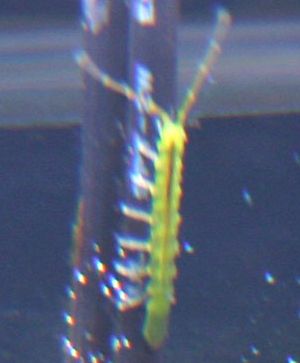
We scraped some green stuff off one of the poles under the Oceanside pier and added some ocean water. Here's one of the creatures we found in it (at 400x).


Does anyone know what this is? We didn't add any stain to the sample. Is the green part chlorophyll? Is it a type of phototrophic bacteria? Please post a comment if you know or have any ideas.

Christmas Germs from Calvin's Jar

Back during the summer, Calvin put water and various plant material in a sealed jar and left it in the sun for all these months. We finally opened it up and decided to see what was inside. Our first discovery were these red and green balls--perfect for Christmas. I think they're bacteria, and I think some are red because I added Eosin Y which stains the outsides of cells red.

This one is at 400x.

And this one is at 1000x. There's one in the lower right corner that appears to be in the middle of dividing (it's bigger than the other red ones). I think the two dark spots are the two copies of the DNA which get separated before it divides into two. In this picture, I think the green ones are a different type of germ.

We haven't found anything moving in it yet, but we'll keep looking and take a movie if we find something.

If anyone knows what these things are, please post it in the comments.

Wednesday, December 24, 2008

The Microscope


The microscope we want is a National Optics DC4-156-S. It's goes up to 1000x and has a camera so we can take pictures and movies to show everyone.

We've been really good this year, so hopefully Santa will bring us the microscope tonight!

Merry Christmas!